 One Nation Under Lee
 He
said the youth in Singapore, especially the students in tertiary
institutions in the 1950s, 60s and 70s were actively engaged in
society. Their language backgrounds were never a barrier as students
from the Singapore University, the Nantah, and the Singapore
Polytechnic came together to speak up on issues not only affecting
youths but also the general public.
He
said the youth in Singapore, especially the students in tertiary
institutions in the 1950s, 60s and 70s were actively engaged in
society. Their language backgrounds were never a barrier as students
from the Singapore University, the Nantah, and the Singapore
Polytechnic came together to speak up on issues not only affecting
youths but also the general public. Pro-govt press interviews renegade filmmakers
The interview below was conducted some two months ago, before the recent announcement by PM Lee on relaxing the ban on political films. What was Straits Times' hidden agenda? Perhaps it's a way to profile us for the Internal Security Department dossiers. Perhaps ST has vested interest to see political films relaxed for their own RazorTV. Perhaps they want to score some brownies in international press freedom rankings. Perhaps, perhaps, perhaps. Oh, whatever.
Film-makers on the fringe
Before
the PM announced recently that the ban on political films was likely to
be eased, they were already documenting scenes of S'pore politics and
producing controversial films that flirted with the law. Meet the
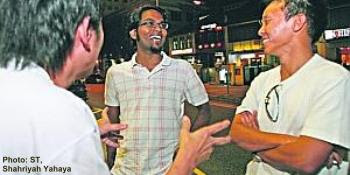
intrepid trio who believe they are rebels with a cause. -ST
Sun, Sep 07, 2008
The Straits Times
By Sue-Ann Chia, political correspondent
WHEN
the death knell sounded on a 10-year-old law that imposes a total ban
on political films two weeks ago, film-maker Martyn See cheered.
The
move marked the biggest effort in 20 years by the Government to loosen
its hold on political expression here, declared the 39-year-old.
As
a mischievous tribute, he pulled together 100 films on local politics,
compiling them on his blog a week after Prime Minister Lee Hsien Loong
said in his Aug 17 National Day Rally speech that an outright ban on
political films was no longer sensible.
The 100 short clips -
'films' is too formal a term to describe them - are the work of
assorted groups and individuals, most with a decidedly
anti-establishment stance.
They include two by Mr See which did
not make the censor's cut. One is on Singapore Democratic Party (SDP)
chief Chee Soon Juan and the other on former political detainee Said
Zahari.
He plans to re-submit them to the Board of Film Censors
once the ban on political films is formally eased - likely early next
year - just to test the new system.
He wants to do so because
the prospective change comes with caveats: Films which are partisan or
give a distorted and slanted impression will still be off-limits.
His
own view is that there should be no caveats. 'If it is not sheer
stupidity to continue enforcing bans on these films when they can be
viewed at a click of a mouse, I don't know what is,' he wrote on his
blog.
How did he come to be such a fighter against Section 33 of the Films Act, which bans party political films?
Political awakening
ATTRIBUTE it to a second political awakening that came in the wake of the 2001 general election.
He had had a first awakening back in the mid-1990s, when a photocopy of a banned book came his way.
The
book was To Catch A Tartar, written by former solicitor-general Francis
Seow, describing his detention under the Internal Security Act in the
late 1980s.
'My eyes were opened to the darker side of the PAP's history,' he says.
'I read it from cover to cover. I felt...frightened, depressed and angry at the same time.'
His
hitherto placid political outlook changed then, but it was only later -
after the November 2001 election - that he was really roused into
action.
What caught his attention was Dr Chee Soon Juan heckling
then prime minister Goh Chok Tong about an alleged loan to former
Indonesian president Suharto.
'Chee Soon Juan got hammered very
badly. I wondered, is this guy as bad as the media made him out to be?
So I decided to check him out myself,' he says.
A few months later, in 2002, he asked to meet Dr Chee.
For
the next two years, he 'interviewed' the SDP leader regularly, visited
him at his home and his office, and observed him when he staged public
protests - filming all the while.
He had reams of footage but no film, until Mr Lee Hsien Loong was sworn in as Prime Minister in 2004.
Mr
Lee's inauguration speech, promising the opening up of civil society,
inspired him to compile his shots into a 28-minute film which he titled
Singapore Rebel.
He submitted it for screening at a film festival. But the film never made it past the censors.
It was deemed 'party political', and banned under Section 33 of the Films Act.
He was questioned four times over 15 months by the police and even had his video camera seized.
'They
dropped the investigation a couple of months after the 2006 general
election. I guess they wanted to watch if I would participate in the
election,' he says.
He never did. But he continued to produce politically incorrect films.
Singapore Rebel
MR
SEE titled his directorial debut Singapore Rebel. Although about Dr
Chee, it sums up Mr See himself - someone bent on capturing alternative
politics on celluloid.
He began his film-making career nearly 20
years ago, right after national service, learning the ropes of video
editing in production houses. Along the way, he became a freelance
video editor, working for renowned local directors such as Mr Eric Khoo
and Mr Jack Neo.
He spends 90 per cent of his time doing such
work to 'pay the bills', but the remaining 10 per cent is now consumed
by his passion - making films on local political issues.
While
being questioned by the police over Singapore Rebel, he produced
another film, on former political detainee Said Zahari. This was also
banned.
His latest, on Dr Chee and the protests he staged during
the IMF-World Bank meetings in 2006, however made the cut. Speakers'
Cornered was given an NC-16 rating and screened at the Substation on
July 26 this year.
Despite the overwhelmingly pro-opposition -
especially pro-SDP - angles in his films, he insists he is not an
opposition supporter or sympathiser.
He says: 'I fill a vacuum
created by the media when they don't cover opposition politicians or
political dissidents. I consider myself a citizen journalist, not a
Michael Moore type of film-maker.'
Asked why he bothers to
submit his films for classification when he can upload them on YouTube,
he deadpans that the law requires it.
The more compelling reason is that he wants to push the envelope in the area of political expression.
'Who
better to do that than me,' he says, 'since I'm already over the OB
markers. I want more film-makers who want to document the political
scenes to emerge.'
In this, he has found a following of sorts.
Mr Ho Choon Hiong, 33, first heard about Mr See when Singapore Rebel was banned three years ago.
He
was among a group of 12 film-makers who wrote to the Government then,
asking for greater clarity as to what constituted a party political
film.
The incident led to him meeting Mr See.
Their subsequent exchanges emboldened him to capture on celluloid assorted scenes of political activism in Singapore.
Unlike
Mr See, he was introduced to politics early by his father, who used to
be a student activist at Chinese High School in the 1960s.
Like Mr See, however, his political interest was stoked by the 2001 polls and Dr Chee.
After
meeting Mr See, he produced a plethora of very short films, on topics
ranging from the 2006 election to protests by Myanmar nationals in
Singapore. He sent six to the film censors for classification in May.
'I have to take a few steps and hope to be undeterred more and more,' says the film studies graduate from Ngee Ann Polytechnic.
'I want to put my own perception of truth out.'
So far, his 'films' have been ignored by the authorities.
A prolific activist
NOT so for Mr Seelan Palay, 24, another amateur film-maker.
He
had his film, One Nation Under Lee, seized by officials from the Board
of Film Censors as it was being screened in a hotel recently.
The reason: It had not been passed by the censors.
His
first effort - detractors panned it as a slide show rather than a film
- it portrayed Singapore as lacking in press and political freedom, and
tightly controlled by Mr Lee Kuan Yew.
Point out that One Nation
Under Lee is decidedly one-sided - it takes potshots at the Government
while hailing Dr Chee as a hero - and he insists he has no political
agenda.
He isn't politicised by anyone either, he insists.
'I learnt everything from reading, out of personal interest,' says the activist.
CITIZEN JOURNALIST
'I fill a vacuum created by the media when they don't cover opposition politicians or political dissidents. I consider myself a citizen journalist, not a Michael Moore type of film-maker.'
-- Film-maker Martyn See
He has been involved at various times with the Vegetarian Society, the Animal Concerns Research & Education Society, and the now defunct SG Human Rights Group.
Earlier this year he attended rallies by Hindu protesters in Kuala Lumpur, and upon his return to Singapore, decided to mount a one-man protest fast outside the Malaysian High Commission.
He also takes part in protest actions organised by the SDP occasionally.
He is not a troublemaker, he insists. He is just doing what he believes in.
Nothing to fear
WHAT keeps the trio going?
'Our conscience pricks us,' says Mr Ho. He sees it as his duty to document what he believes gets sidelined by the mainstream media.
The trio use the same counter when you point out that their version of 'truth' sometimes takes an extreme slant. Others have noted that it was the publicity over the banning of some of their films, rather than the quality of the films themselves, that made the public more keen to view them.
But they are not perturbed.
For Mr See, his mission is simple.
'I live by the Singapore Pledge. I live by the Constitution that guarantees freedom of expression, association and assembly,' he says.
And he aims to guard these freedoms by showing that there is nothing to fear.
The other two, less articulate about their aims, appear to go with the flow as acolytes of Mr See, enjoying the thrill of defiance every once in a while.
They are all drawn to Dr Chee, whom they see as championing freedom of expression and provoking the Government with his illegal public protests.
Still, they say, they have no intention of joining the SDP or any political party. Ironically, they fear being hemmed in by party discipline.
Mr Palay, for instance, will tell you that he supports the SDP's cause but has no wish to sign on as a member.
Have they made an impact on the political scene? They believe so, pointing to more local film-makers who remain anonymous but, like them, upload political-type films on YouTube.
They also claim some credit for the Government's decision to consider lifting the ban on political films.
It was, they say, the banning of Mr See's Singapore Rebel that sparked a debate on the relevance of the Films Act.
Future films
FOR now, the three men have film ideas that they hope will see the light of day.
Mr Palay wants to do a film on the unspoken rule limiting use of dialects in films.
Mr Ho is aiming to do documentaries on two women: Dr Chee's wife, and his own long-lost Malaysian nanny whom he is still trying to locate.
As for Mr See, he has two targets too. One is the reclusive former political detainee Chia Thye Poh. The other is Minister Mentor Lee Kuan Yew.
In the latter film, he wants to trace the People's Action Party's formation and rise to the pinnacle of power in Singapore.
Why do a film on the PAP when its story has been told so many times before? 'It is a compelling story,' he says.
So are they really rebels with a cause?
Says Mr See: 'There's definitely a purpose to what we're doing. I see it as lessening the climate of fear here.
'I want more film-makers like me to emerge, wanting to document the political scenes in Singapore.'
This article was first published in The Straits Times on Sep 5, 2008.


 So many had gone bankrupted for such incidents liao...