Cat Breed of the Week!!
-
The Russian Blue
Body: Fine-boned, long, firm and muscular, with long and fine boned legs.
Coat: Short, dense, fine and plush in an even blue throughout. Guard hairs are silver-tipped, giving the cat a lustrous appearance.
The Russian Blue has vivid green eyes, which are a striking contrast to its silvery-blue coat.
History and Personality:
The history of the Russian Blue is couched in rumor and legend. The Blue was originally known as the Archangel Cat, as it is believed thay were brought by sailors from the Archangel Isles to England in the 1860s.
The physical beauty of the Russian Blue is complemented by its loving, quiet disposition. Although shy in nature, Russian Blues are affectionate intelligent, and playful with their human companions. They get along with children and other pets, making them a fine addition to a family. If you are a single household, the Russian Blue will fit equally well, as he can entertain himself while you are gone and welcome you with his smiley face when you return.
-

-
TICA's Best Russian Blue 2004Originally posted by care bear:
SGC IW Talisker Laurent
2004 TICA Best Russian Blue cat
br: Amanda Bright - Bailey McLeod
ow: Amanda Bright - Chieko Ohira
Photo copyright © Chana -
a seductive russian blue


-
Originally posted by poon cho tang:a seductive russian blue

I like!!!!!! -
Looks a bit ... erm, grim for me. I like cute cats betterOriginally posted by poon cho tang:a seductive russian blue
-
OMG GORGEOUS CAT!!! MEOW MEOW..
-
This is my favourite...
British Shorthair
The British Shorthair, probably the oldest English breed of cat, traces its ancestry back to the domestic cat of Rome. This breed was first prized for its physical strength and hunting ability, but soon became equally recognized and valued for its calm demeanor, endurance and loyalty to man.
The British Shorthair is a comparatively rare cat in the United States. Around 1980 it was recognized for championship competition by CFA stimulating much needed interest in the breed. Recognized world-wide, many fine “Brits” are still imported today from England, Ireland, New Zealand and Australia to help widen the gene pool for breeders in the United States.
The British Shorthair is gaining in popularity every year as it is bred and exhibited by an increasing number of enthusiastic fanciers. Because of its easy-going nature and intelligence, it has become a favorite of animal trainers, for use in Hollywood films and television commercials. The British Shorthair has a short plush coat with a luxurious feel which is very easy to groom. A British Shorthair is always in quiet control of his or her environment, supervising everyone and everything that happens in the family. A larger sized cat that prefers to be on the ground, Brits are not known for acrobatics or speed. However, they are steadfast companions to the entire family and definitely look before they leap. When gracelessness is observed, the British Shorthair is duly embarrassed; quickly recovering with a “Cheshire Cat smile.”
Although first known as the British Blue, due to the breedÂ’s original color, its native country incorporated a wide variety of colors under the term British Shorthair in the 1950Â’s. CFA also now recognizes the British Shorthair in many different colors and patterns. -
my fav

-
Breed of the Week - the Norwegian Forest Cat
Bright emerald green eyes with a band of gold. Long flowing hair. Sweet-expressioned faces. Jaunty ear and toe trimmings. Each time you see a Norwegian Forest Cat is a feast for the eyes. Each time you touch their spun-silk soft coats is a delight to the fingertips.
These are the cats that explored the world with the Vikings, protecting the grain stores on land and sea, and which are believed to have left their progeny on the shores of North America as a legacy to the future.
These lovely cats are really two for the price of one, they can differ so greatly in looks from summer to winter. Some time in the spring they take off their “winter underwear,” the downy undercoat that provides warmth, and the long non-tangling outer guardhairs that act as protection from rain and snow. The contrast can be quite extreme. The inner-ear hair that deflects the wind and snow (and can be three to four inches long, curving out and around the ear like flexible racing stripes) remains all year. The tail is always magnificent, being as much as twelve inches or more when fanned to its fullest. Perhaps the most impressive part of the coat is the mane. On a fully mature cat, i.e. one over five years of age and which is challenged by the most adverse cold weather, the mane is nothing less than spectacular. It is long, dense and very, very impressive! This, unfortunately, may disappear in the spring, but rest assured that it will begin to lengthen again as the days begin to shorten.
These cats are designed by Mother Nature. They appear in coats of most colors, from pure white to deepest coal black, with every possible coat pattern and color combination in between, with the exception of the colorpoint colors as seen in the Siamese or Persian-Himalayan such as seal point or chocolate point. Darker cats require less coat to keep warm since they absorb more heat from the sun. Lighter cats tend to have fuller coats with more undercoat. Some colors change from light to darker tones with the seasons. Mother Nature is so thoughtful! And, finally, because they are a natural breed, their mature size will differ from line to line.
Is their Norse name accurate? Yes, the skogkatt, meaning forest cat, really did come out of the Scandinavian forests some time in the last 4,000 years. However, they are not feral but are among the most people-oriented cats. Of course their personalities differ, depending upon the type home in which they spend their early kittenhood. As with any other breed, a kitten handled and petted by many loving people from birth and which has been exposed to children, cats and dogs will be different from one born and raised in an isolated area with limited human contact.
A question frequently asked is about the care the long coats require. As one breeder is fond of saying: “Mother Nature does not have hairdressers in the deep woods, so she did not design the cat to require the daily attention necessary to some other longhaired breeds.” Very little, if any, combing is required for non-show cats, but is recommended during spring shedding.
The Forest Cat was presented to the CFA Board for registration acceptance in February 1987, and in 1993, these wonderful works of art from nature were accepted for full championship status.
-

 [/list]
 -
aristocat
-
any vietnamese here? they will be drooling at those pictures by now
-
so impressive yah?!! the manes are gorgeous, makes them look so majestic!!Originally posted by poon cho tang:aristocat -
I like this one! The look on her face... the adoring look~Originally posted by care bear:[b]Breed of the Week - the Norwegian Forest Cat[/b][/quote]
Looks like... very fat under the head... majestic indeed..~
[quote]Originally posted by care bear:[/list] -
!!!!!!!!!!!!!!!!!!!!!!!!!!!!!!!!!!!!!!!!! U FEED CATS TOO?!?!?!?!Originally posted by poon cho tang:my fav
SAME HERE!!!!!
I love our own local breed!!! hahaha..
I've got a cat at home too!!!! She's simple the cutest I ever seen!!!!!!!!!!! 
-

The Singapura Cat (Kucinta)
The original home of the Singapura is the island of Singapore, with the breed taking its name from the local Malay name for the island - meaning ‘Lion City. The breed is the result of mother nature’s combination of genes indigenous to South East Asia - both the brown as in Siamese and Burmese and the agouti or ticked pattern. The area is the highest epicentre for the agouti gene, according to geneticist, Neal Todd, who has published articles on the migration of feline genes. This breed is the same colour as seal point cats or brown Burmese, but the difference is the agouti coat pattern and how it interacts with the sepia brown.
The first Singapura cats to appear were imported into America from Singapore by Hal and Tommy Meadow in the mid-seventies, having been found and adopted in the Loyang area by a geophysical work boat crew. The breed was carefully developed from Ticle, Pusse, Tes, George and Gladys, the latter two being offspring from Ticle and Pusse. In 1980 a further cat, Chiko, was imported from the SPCA (Singapore equivalent to RSPCA) into America. The look of the cat as determined by these early imports, remains unaltered today. In July 1990, the Singapore Tourist Promotion Board nominated the breed as a "travel mascot" and had a contest to determine its name. Kucinta, meaning "love cat”, was the winner. Kucinta has since been the object of worldwide promotions and publications. She has even been named a National Treasure by the Singapore Government
The Singapura is an alert, healthy, medium sized cat of foreign type. The body has good bone structure and is moderately stocky and muscular, yet gives an impression of great elegance. Females are usually smaller than the males, but still feel heavier than they look. The strong slender legs taper to small oval feet. The tail should be slender but not whippy. and should have a blunt tip. Body colour is an old or golden ivory with a soft warm effect, ticked with sepia brown. Each hair has at least two bands of sepia brown ticking, separated by light bands - light next to skin, and dark tip. Muzzle, chest, stomach and inner legs are an unticked light ivory colour. Singapuras should have some barring on their inner front legs and back knees. The coat is short, fine, silky, and close-lying.
The breed has noticeably large eyes and ears. Eyes are large, set not less than an eye width apart, held wide open, but showing slant when closed or partially closed. A dark outline to the eyes is desirable. Eye colour hazel, green or yellow only. Ears are large, wide open at base, and deep cupped. The outer line of the ears extends upwards to an angle slightly wide of parallel. The head is gently rounded with a definite whisker break and a medium short, broad muzzle with a blunt nose. In profile, the Singapura has a rounded skull with a slight stop just below eye level. There must be evidence of dark pigment outline on the nose. ‘Cheetah’ lines from the inner corner of the eye towards just behind the whisker pad should be present
To be owned by a Singapura is like having another member of the family, a caring affectionate and sensitive friend. They have soft, gentle voices and love human company.
Dribbling and fetching ping pong balls is mastered at a very early age. A great artist - the Singapura will take on many personas, they play and frolic, ‘help’ you read the paper by walking all over it (after all you should be fussing them), scale curtains, legs, cupboards and door frames, and love sitting on shoulders or curling up on laps. They also do an amazing hot water bottle impression when it is late and cold, and spend hours of vigil sitting on your chest when you are feeling unwell. Being vigorous cats they are active and lively, with a love of warmth. Their stature makes them gentle cats, but they are also playful, and remain so throughout their lives, even the older cats enjoying a wild game. They are mischievous, and inquisitive, meaning that they will investigate anything thoroughly - especially when they shouldn’t - but that is part of their charm.
-

-

-
kawaii ne!!!!!!!!!!!!!
-
ironically the singapura is not common in singapore
-
Siberians
Siberians have been around for at least one thousand years as far as recorded history. They were first mentioned in Harrison Wier's book Our Cats and all About Them, which included information about one of the earliest cat shows held in England in 1871. However, finding written information in Russia is fairly difficult. Despite the fact that the Siberian is a natural breed and is the national cat of Russia, its very ubiquity makes it taken for granted rather than worthy of note in Russian literature. Add to this the vast expanse of Russia which encompasses 13 time zones as well as a multitude of ethnic and cultural diversity and you have a cat that seems as difficult to standardize as the country which gave rise to it.
The Siberian was first imported in 1990. Despite it's popularity the Siberian is extremely rare in the United States. Most breeders have waiting lists for their kittens.
The Siberian, considered a semi longhair, has a rich full coat in the winter while the summer allows for a somewhat shorter less dense coat. The Siberian can come in just about every color of the rainbow but because of the rarity of the breed those colors may not be available in your neighborhood. The Siberian was accepted into the Miscellaneous class by CFA on February 6, 2000.
The Siberian tends to be both a great problem solver and also, rather like dogs, are loyal to their adopted families which is why they are so well suited to the households in which one spouse, usually a husband or significant other, professes to be a "dog person" not a "cat person." Often it is that same "dog person" who is greeted at the door by their Siberian and after being dutifully followed around the house by their Siberian, then decides that one Siberian is simply not enough! Siberians are extremely agile and can leap great distances and heights to "fly through the air with the greatest of ease!" However, their agility also means they usually navigate potentially breakable brick-a-brac without leaving a path of destruction in their wake. Prudence dictates that one would still want to think twice about placing a Ming Dynasty vase on the mantle. A delightful combination of the flying Walenda's and the sleuth "the Pink Panther," the Siberian is a zany mixture of both. Expect the unexpected when sharing your home with a Siberian.
Pricing on Siberians usually depends on type, applicable markings and bloodlines distinguished by Grand Champion (GC), National, National Breed and/or Regional winning parentage (NW, BW, RW) or of Distinguished Merit parentage (DM). The DM title is achieved by the dam (mother) having produced five CFA grand champion/premier (alter) or DM offspring, or sire (father) having produced fifteen CFA grand champion/premier or DM offspring. Usually breeders make kittens available between twelve and sixteen weeks of age. After twelve weeks, kittens have had their basic inoculations and developed the physical and social stability needed for a new environment, showing, or being transported by air. Keeping such a rare treasure indoors, neutering or spaying and providing acceptable surfaces (e.g. scratching posts) for the natural behavior of scratching (CFA disapproves of declawing or tendonectomy surgery) are essential elements for maintaining a healthy, long and joyful life. -

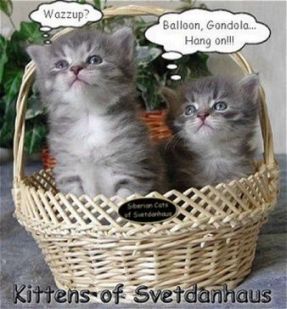
aren't they lovely?? -
Yes they are !!!!
-
The Tonkinese
Nothing quite matches the enthusiasm of Tonkinese admirers for this cat, which has a colorful personality to match its colorful coat. Developed from a cross of the Burmese and Siamese cats, the Tonkinese glorifies the best of both breeds.
Tonks are ideal companions, highly intelligent and curious. They will dream up dozens of games you can play with them, and love to retrieve and play "hide 'n seek," either with a human or another Tonk. Give your Tonk plenty of activity toys, and work out with them regularly to keep them from being bored. A bored Tonk can be a mischievous Tonk, so if you are gone long hours, you might want to consider two of these splendid cats.
Breed Brief:
Size: Medium sized, dense and muscular, neither cobby nor svelte. Legs and feet are fairly slim, proportionate to the body, with hind legs slightly longer than the front.
Coat: Medium short, fine, soft and silky, close-lying to the body, with a lustrous sheen, in point colors of natural mink, champagne mink, blue mink, and platinum mink